Python FutureLab
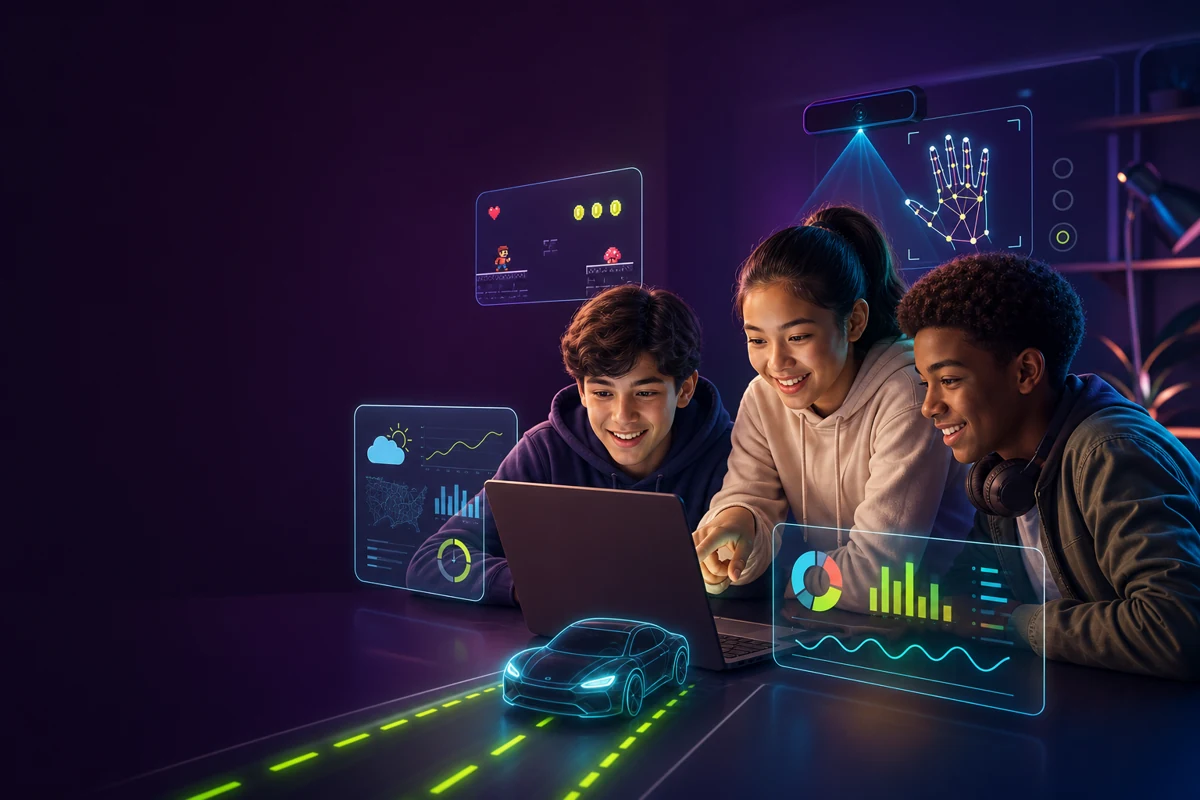
Ages 10–18. Start with Python, then build apps, games, AI experiments and computer-vision projects. Beginner-friendly, with a portfolio to show what they can do.
2 h / session
No experience needed
What they will learn
- 01–06 · Python essentials: Variables, decisions, loops and functions. Build a checkout tool and quiz, then practise debugging.
- 07–12 · Smart apps: Lists, dictionaries, CSV, JSON and APIs. Make a tracker, weather app and file organiser.
- 13–18 · Game systems: Pygame, inputs, sprites, collisions and game states. Create a space game, obstacle course and smart-city simulation.
- 19–24 · Data, AI & safety: Clean and chart data, compare rules with machine learning, and explore accuracy and privacy. Prototype a recommender and scam flagger.
- 25–32 · Computer vision: NumPy, image filters, OpenCV, contours and hand landmarks. Build a document scanner, AR filter and tracker.
- 33–36 · Mobility & capstone: Detect lanes in recorded video and classify images with a pretrained model. Test, document and present a recycling-AI or vision project.
Put their skills to work
Apps. Games. AI vision. A portfolio of their own.
- Build a game, a smart app and an object detector.
- Python skills used in data, software and AI.
Competition pathway
Project portfolio
This pathway culminates in a project portfolio, student demonstration and CNRS × Kavosh certificate. Competition entry is not included; mentors can discuss a next-step robotics pathway.
- 01–12 · Python & smart apps
- 13–24 · Games, data & AI
- 25–36 · Vision & final project
Your hub confirms placement, availability and schedules. Competition participation depends on eligibility and readiness; awards and university admission are not guaranteed.
Find a course & book a trial